DERS
Distribution of Eccentric Rotational Skin-Stretch Induce Directional Force Sensation on a Wrist
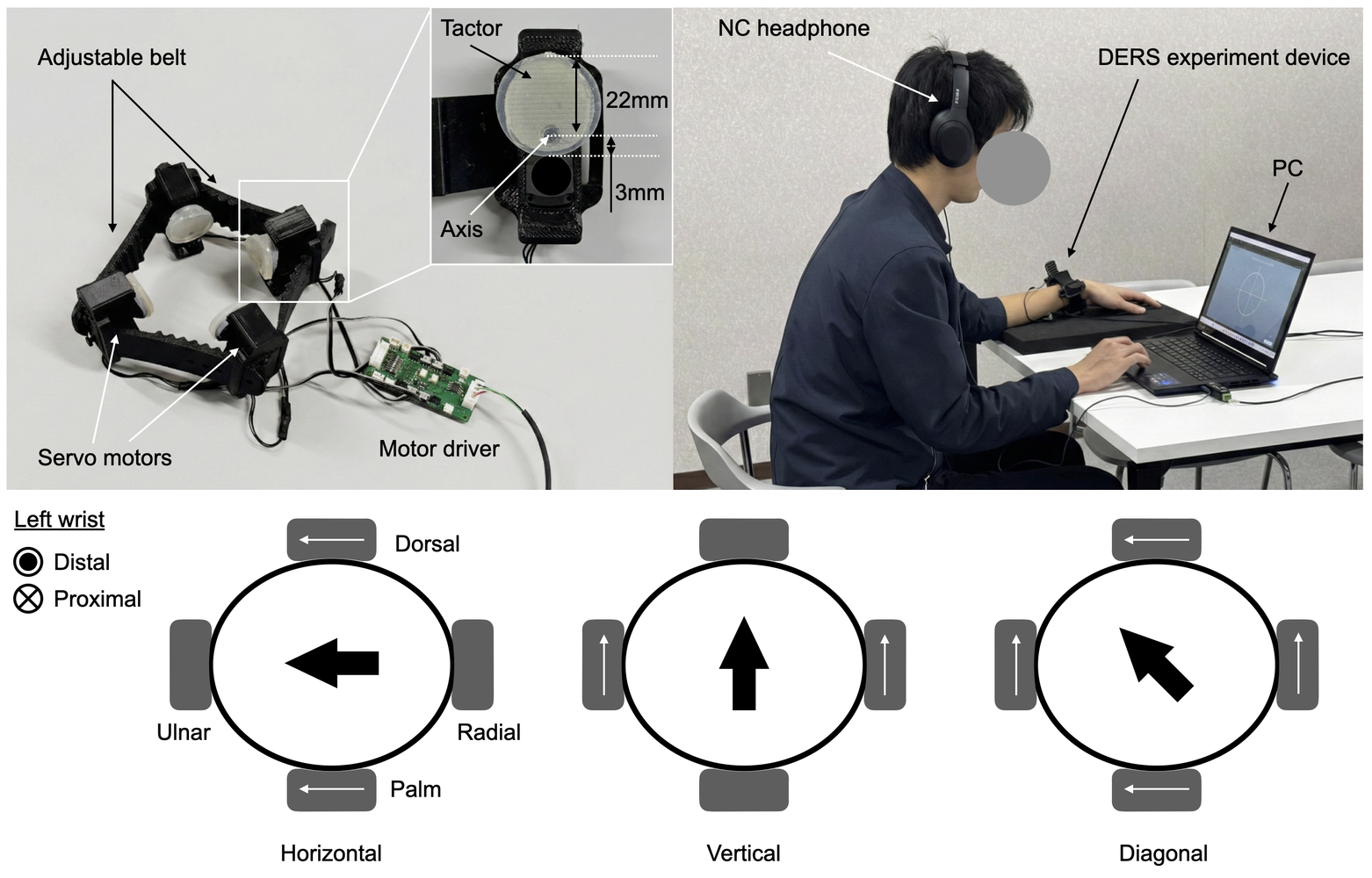
Presenting force-tactile feedback while keeping the hand free and maintaining perceptual transparency is a crucial challenge for natural interaction. We propose DERS (Distribution of Eccentric Rotational Skin-stretch), a novel skin-stretch stimulus method using eccentric rotation.
DERS employs tactors with rotation axes offset from the center of the contact surface, generating directional shear deformation on the skin through rotational motion. The system presents two-degree-of-freedom force direction and intensity without additional mechanical grounding by coordinating eccentric tactors placed at four locations around the wrist.
Two psychophysical experiments were conducted. Perceived intensity followed Stevens’ power law with a near-linear exponent. Direction classification was high on the palmar, dorsal, and radial sides but lower on the ulnar side, where the ulnar styloid process limits uniform skin contact. In the eight-direction experiment, responses were significantly concentrated toward the target for most directions, with cardinal directions more accurately localized than diagonals.
Publications
- Kotani, A., Shimobayashi, H., & Horie, A. (2026). DERS: Distribution of Eccentric Rotational Skin-Stretch Induce Directional Force Sensation on a Wrist. In: EuroHaptics 2026. LNCS, vol 16593, pp. 249–258. Springer. https://doi.org/10.1007/978-3-032-32230-2_19 (Co-first author)